
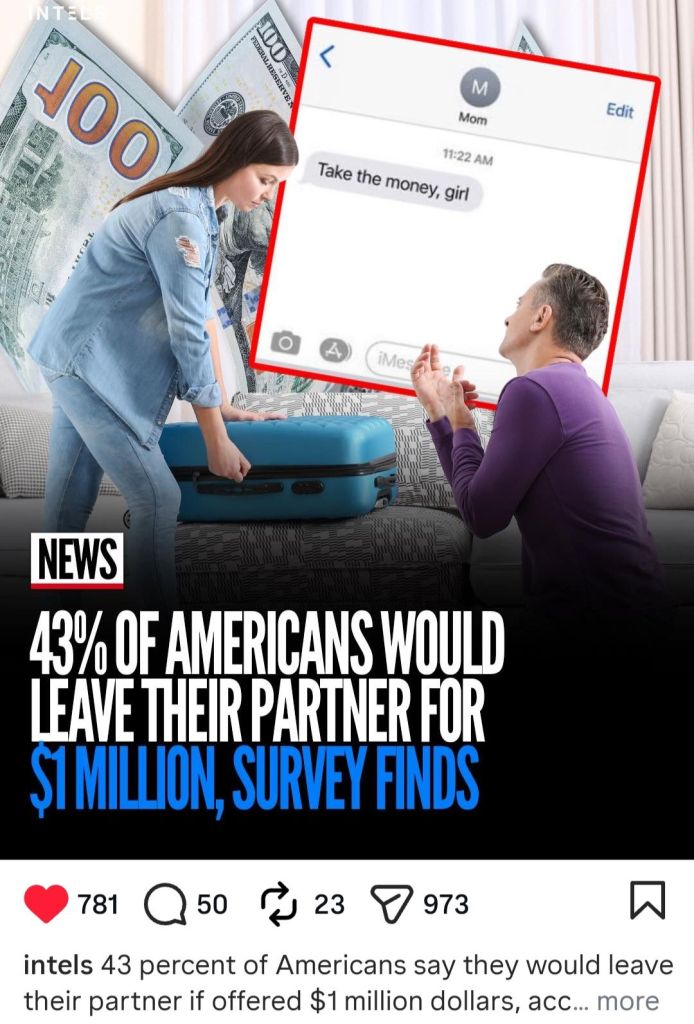
A recent survey found that 43% of Americans say they would leave their partner if offered $1 million.
At first glance, the statistic feels outrageous. Cold. Transactional. Maybe even cynical.
But as a divorce lawyer who spends her days at the intersection of love and money, I don’t find it shocking at all.
I find it revealing.
Because this isn’t really a story about greed. It’s a story about financial stress, economic insecurity, and how deeply money influences modern relationships.
Hypotheticals vs. Reality
Before we spiral into moral judgment, let’s remember: survey answers are hypothetical. Saying you would leave and actually filing for divorce are two very different things.
Still, the number matters.
When nearly half of respondents say they would choose $1 million over their partner, it suggests that many people do not feel economically safe within their relationships, or perhaps not emotionally fulfilled enough to reject that kind of financial freedom outright.
In my practice, I often see that divorce is rarely about a single betrayal. It’s about cumulative strain. And financial strain sits near the top of the list.
Money Is the Third Person in the Marriage
We talk about infidelity. We talk about communication. We talk about intimacy.
But we don’t talk enough about money as a silent third party in many marriages.
Financial stress is consistently one of the leading causes of relationship conflict in the United States. Rising housing costs, childcare expenses, student loans, elder care, and career instability create pressure that seeps into every corner of a partnership.
When people imagine $1 million, they’re not just imagining luxury cars.
They’re imagining:
Paying off debt
Owning a home outright
Funding college
Escaping paycheck-to-paycheck anxiety
Buying back peace of mind
For some, the hypothetical isn’t “money versus love.” It’s “security versus survival.”
That’s a very different equation.
What This Says About Relationship Satisfaction
Here’s another uncomfortable truth: happy people in secure relationships don’t usually fantasize about exit strategies.
When someone says they would take the money, it may reflect:
Feeling undervalued
Feeling unsupported
Feeling financially trapped
Feeling emotionally disconnected
Feeling exhausted by unequal contribution
In many divorces, one spouse says some version of: “I’ve been carrying everything.” Maybe that’s about money, or maybe (in fact often) it’s about the domestic load.
Resentment often runs deeper than people realize. It’s not just about who earns more. It’s about transparency, respect, shared goals, and autonomy.
Money represents power. And power imbalances corrode relationships over time.
The Cultural Shift
There’s also a broader cultural shift happening.
Previous generations often stayed in marriages due to economic dependence. Today, more people, especially women, are financially independent or aspire to be. The idea of choosing financial freedom over a strained relationship is no longer unthinkable.
At the same time, the cost of living has soared. A million dollars doesn’t represent extravagance in many parts of the country — it represents stability.
In cities like New York or Los Angeles, $1 million is not generational wealth. It’s a down payment and breathing room.
That context matters.
The Prenup Conversation
This survey also highlights something I often tell clients: love and money are not opposing forces. They are intertwined.
Couples who openly discuss finances, their expectations, debts, earning trajectories, risk tolerance, are far better positioned for long-term stability.

A prenuptial agreement, for example, is not a plan to fail. It’s a framework for transparency. It forces couples to confront economic realities before resentment builds.
Financial clarity strengthens relationships. Financial secrecy erodes them.
If 43% of people are willing to hypothetically walk away for money, perhaps the real issue is that we’re not talking honestly enough about money inside relationships.
What This Really Means
The headline invites outrage. But the deeper takeaway is this: people crave security.
When individuals feel economically vulnerable, they imagine escape routes. When they feel emotionally unseen, financial independence looks even more attractive.
The survey doesn’t prove that love is dead. It proves that financial stability is deeply tied to how we experience partnership.
Strong relationships are built on:
Mutual respect
Shared financial vision
Transparent communication
Emotional safety
Economic fairness
Take those away, and $1 million starts to look less like greed and more like oxygen.
As someone who works daily with people untangling marriages, I can say this with confidence: money alone doesn’t destroy relationships. But unresolved financial tension absolutely can.
The real question isn’t whether you would leave for $1 million.
The real question is whether your relationship feels strong enough that no price tag could compete. And if it doesn’t, well, that’s worth examining long before someone hypothetically writes the check.
 The Divorce Artist™️